CALENDARS & BRANDING
Table calendar formats: 6, 7, 12 and 13 sheeters explained
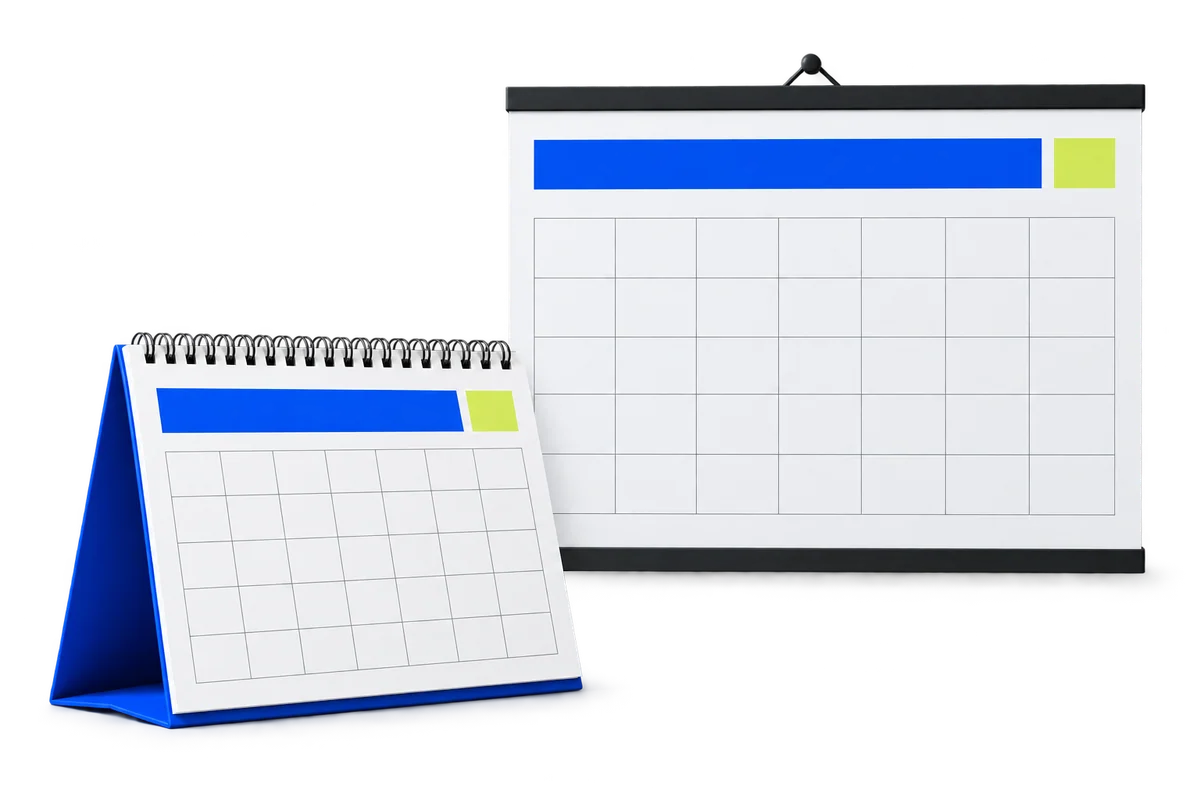
A table calendar's format is its sheet count: a 6-sheeter carries two months per sheet printed front and back, a 7-sheeter adds a cover, a 12-sheeter gives each month its own sheet and a 13-sheeter adds a cover to that. Sheets are wiro-bound to a folded stand on 300 GSM board, laminated both sides, and the format decides both the cost and how much space the brand has each month.
What each format carries
A 6-sheeter has six sheets, each printed on both faces, so each sheet shows one month on the front and the next on the back; the recipient flips the sheet over the wiro every month. A 7-sheeter is the same with a seventh sheet as a cover — the brand image sits on the desk through January until the first flip.
A 12-sheeter has twelve sheets, one month on each face that shows. Printed single side, the back of each sheet is blank and the format reads as a clean month-per-page calendar. Printed front and back, the reverse of each sheet carries a second image or message, so a recipient flipping to February sees January's reverse on the back — twelve extra brand pages. A 13-sheeter adds a cover to either version.
Single side or front and back
Single-side printing is cheaper and makes sense for 12 and 13-sheeters where the month image is the point. Front-and-back printing is what makes a 6-sheeter possible at all (two months must share a sheet), and on a 12 or 13-sheeter it doubles the content for a modest increase in cost — the board, lamination and binding are the same; only the printing changes.
Decide by what you have to say. A pharma brand with twelve products wants twelve month faces and twelve reverse faces; a cement dealer calendar wants a big grid and one strong brand image, which the 6-sheeter delivers at the lowest price per piece. The ranges are set out on the table calendar manufacturer page.
Board, lamination and the stand
All sheets are 300 GSM board — stiff enough to stand upright and to flip cleanly over the wiro without sagging. Lamination on both sides, matt or gloss, protects the print from finger marks and tea and stops the board absorbing moisture and curling in humid cities. Matt reads better under office lighting and shows fewer fingerprints; gloss makes product photography brighter.
The stand is a folded piece of the same 300 GSM board, creased into a triangle or tent and bound into the wiro with the sheets. Its front face is visible all year below the sheets, so it should carry the logo, address line, phone and a QR code rather than be left blank. A wider stand sits more stably on a crowded desk; a shallower one ships flatter.
Sheet size and the date grid
Common table calendar sheets run around 8 × 6 inches to 9 × 7 inches landscape; the grid for one month needs at least a third of that height to stay legible. Numerals should be 14 pt or larger, Sundays and holidays distinguished by colour as well as weight, and the previous and next month shown small at the foot where there is room.
Mark national holidays and the state holidays of the regions you distribute to; a calendar going to Maharashtra, Tamil Nadu and Uttar Pradesh may need three regional versions or a single version carrying only national dates. Festival dates for 2027 should be checked against an official list before the proof is signed.
How to plan the artwork
Work out the sheet count first, then the number of printed faces, then assign content to each face: cover, twelve months, twelve reverses (if any) and the stand. Supply images at 300 dpi at the final size with 3 mm bleed on every edge, keep the logo and key text at least 10 mm from the wiro edge where the holes are punched, and allow for the top 12–15 mm being partly hidden behind the wiro and the sheet above.
Send fonts outlined or as PDF/X files. If you are giving us images and text rather than finished layouts, our designers build the grid and the layouts and send a PDF proof of every face; a printed sample follows by courier if you want to see the lamination and stand in hand. For theme ideas see calendar design ideas for 2027.
At a glance
| Format | Sheets | Printed faces | Months per sheet | Extra brand pages | Budget band |
|---|---|---|---|---|---|
| 6-sheeter F/B | 6 | 12 | 2 (front and back) | None | ₹ |
| 7-sheeter F/B | 7 | 14 | 2 | Cover | ₹ |
| 12-sheeter S/S | 12 | 12 | 1 | None | ₹₹ |
| 13-sheeter S/S | 13 | 13 | 1 | Cover | ₹₹ |
| 12-sheeter F/B | 12 | 24 | 1 + reverse | 12 reverse pages | ₹₹₹ |
| 13-sheeter F/B | 13 | 26 | 1 + reverse | Cover + 12 reverse pages | ₹₹₹ |
Questions buyers ask
What is the difference between a 12-sheeter and a 13-sheeter?
The 13-sheeter adds a cover sheet on top of the twelve month sheets. The cover carries a brand image through January and protects the first month in transit.
Why is a 6-sheeter cheaper than a 12-sheeter?
Half the board and half the lamination. Both faces of each sheet are printed, so two months share one sheet, which also keeps the courier weight down on large lots.
What GSM is a table calendar?
300 GSM board, laminated on both sides in matt or gloss. The lamination keeps the sheets flat and clean through a year of flipping.
Should we print the back of a 12-sheeter?
If you have twelve products, projects or messages to show, yes — the board and binding cost the same, only the printing is added. If you have one brand image, a single-side 12 or 13-sheeter or a 6-sheeter is the better buy.
What size are the sheets?
Usually around 8 × 6 to 9 × 7 inches landscape. The grid should take at least a third of the sheet height so the numerals stay readable from arm's length.
Related pages
- Table Calendar ManufacturerWiro-bound desk calendars on 300 GSM, 6 to 13 sheets, for dealers and clients nationwide.
- Corporate calendar design ideas for 2027Design ideas for 2027 corporate table and wall calendars: twelve-month themes, legible date grids, festival marking, product-per-month and logo placement.
- Wall Calendar Printing17×22 inch wall calendars on 170 GSM with metal strips, from 1,000 pieces.
- When to order 2027 diaries and calendars: a week-by-week timelineWeek-by-week timeline, Oct–Dec 2026, for ordering 2027 diaries and calendars: artwork, sample, 5–10 day production, zone-wise dispatch, January handover.
More guides
- Diary sizes, paper and GSM explainedA4, B5, A5 and A6 diary sizes in mm, what 70 GSM paper means, realistic page counts, hardbound versus wiro binding, and which extras are worth paying for.
- PU leather vs genuine leather diariesPU leather and genuine leather diaries compared: feel, cost band, logo methods, how each wears over a year, and which suits clients, staff and dealers.
- Corporate calendar design ideas for 2027Design ideas for 2027 corporate table and wall calendars: twelve-month themes, legible date grids, festival marking, product-per-month and logo placement.
- How to budget corporate gifts per recipientHow to budget corporate gifts per recipient: tier the list, use quantity bands, know what moves the per-piece price, and plan packing and dispatch costs.
- Corporate gifting guide: what to give, how to brand it, when to orderItems, budgets, logo methods and timing.
BEFORE YOU ORDER
Turn this guide into a clear specification
Choose the essentials
Note the format, recipient and features that matter to this order.
Compare like for like
Keep size, quantity, material, branding and packaging consistent when comparing quotes.
Approve the details
Check the artwork and written specification together before production.